Our Blog

Heading Off to College? Maybe It’s Time to Graduate to an Electric Toothbrush!

January 20th, 2021

Your trusty manual toothbrush has been with you from pre-school through high school—well, obviously not the same manual toothbrush, because that would be seriously unhygienic—but it’s the kind of toothbrush you’re used to and comfortable with.

Now, though, you’re off to college, and your lifestyle will be changing. Late night study sessions complete with study session snacks. Getting caught up in a project and making dinner from dorm vending machines. Grabbing fast food on the way to the practice field, or work-study job, or evening class. You get the point—meals can be hectic, unscheduled, and less than tooth friendly.

And if you’re wearing braces or aligners, you know you need to keep on top of brushing more than ever. It’s challenging to brush away cavity-causing plaque when it sticks around brackets and wires. And with aligners, teeth don’t benefit as much from the constant cleansing action of saliva, so it’s really important to brush away plaque and food particles before you replace the aligners after eating.

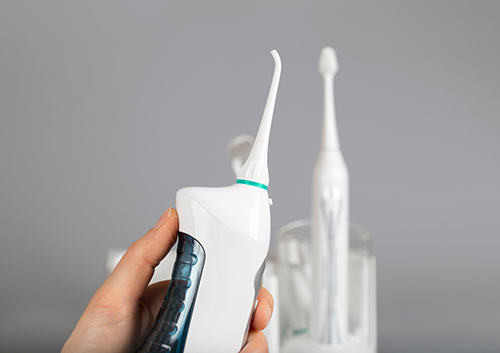
Maybe it’s time to consider an electric toothbrush. After all, anything that can make your life easier and more efficient during busy college days deserves a spot in your dorm room.

  • Electric Brushes Are Effective

The most important reason to switch to an electric toothbrush is its effectiveness. Several studies have shown that regular use of an electric toothbrush leads to a marked reduction in plaque, that bacteria-filled film which sticks to the teeth and leads to cavities and gingivitis. And it’s really no surprise that an electric brush can out-perform a manual brush.

Electric toothbrushes offer several design options, from oscillating/rotating brushes to oscillating/rotating/pulsating models to brushes using sonic vibration technology. What these technologies all have in common is the ability to remove plaque far more efficiently than we can on our own, because electric brushes provide the equivalent of thousands and even tens of thousands of brushstrokes per minute, compared to the hundreds we can achieve by hand.

There might be a bit of a learning curve to discover how to use your brush around wires and brackets. Ask us for the best method of using an electric brush with your braces, and check out brush heads specifically designed for orthodontic work.

If you use buttons with aligners, electric toothbrushes should be safe to gently clean around the buttons to remove built-up plaque. It’s usually best to stick with a manual brush for cleaning your aligners themselves—we’re happy to give you your best cleaning options, no matter which brush you choose.

You know by now what your brushing habits are like. If you tend to be a bit cavalier with your brushing and flossing, make sure you set yourself up for success. Because you have better things to do during semester breaks and summer vacations than visiting Dr. Tony Skanchy!

  • Electric Brushes Can Make Life Easier

Several of today’s electric brushes come with options designed to do more than simply remove plaque. They can let you know if you’ve brushed for the recommended two minutes and remind you when it’s time to replace the brush head. They can even alert you if you’re brushing too hard, which is especially important when you’re wearing braces.

Want more from your electric brush? Some models offer apps that can map out just where you’ve brushed, in case there are a few spots that often get overlooked. Or provide different brushing modes for daily cleaning, deep cleaning, whitening, and more. Or come with a travel case that can recharge while you’re busy exploring the world—or going home for a visit.

In the end, it’s up to you. Do some independent study and research the toothbrushes that will give you the best results for your individual brushing habits. You might not need or want a brush with all the technological bells and whistles.

If you’re comfortable with your manual brush and you get good grades when you visit our Sandy, UT office, stick with it. But if you think you might benefit from the ease and efficiency of an electric toothbrush, if an electric toothbrush makes your teeth and gums healthier and your smile brighter, that’s extra credit worth pursuing.

Dental X-rays: The Inside Story

January 13th, 2021

We’re all friends here, so if you sometimes feel a bit nervous before your orthodontic appointments, no judging! Ask us about any worries you might have. We are happy to explain procedures, equipment, and your orthodontic options so you know exactly what is going on during treatment. And if X-rays are a concern, we can put your mind at ease here as well.

What Exactly Are X-rays?

Sometimes patients feel reluctant about the process of imaging because X-rays are a kind of radiation. But the fact is, radiation is all around us. We are exposed to radiation naturally from our soil and water, sun and air, as well as from modern inventions such as cell phones, Wi-Fi, and air travel.

Why is radiation so common? Because matter throughout the universe constantly gives off energy, and the energy that is emitted is called radiation. This radiation takes two forms—as particles (which we don’t need to consider!) and as traveling rays. This second type is known as electromagnetic radiation, created by photons traveling in regular waves at the speed of light.

We are exposed to electromagnetic radiation every day, because, whether we can see them or not, these different wavelengths and frequencies create various forms of light. Radio waves, microwaves, infrared, visible, and ultraviolet light, X-rays, and gamma rays are all part of the electromagnetic light spectrum.

Different types of radiation on this spectrum have different wavelengths and different frequencies, and produce different amounts of energy. Longer wavelengths mean lower frequencies and less energy. Because X-rays have shorter wavelengths and higher frequencies than, for example, radio waves and visible light, they have more energy.

How Do Dental X-rays Work?

An X-ray machine produces a very narrow beam of X-ray photons. This beam passes through the body and captures images of our teeth and jaws on special film or digital sensors inside the mouth (intraoral X-rays), or on film or sensors located outside the mouth (extraoral X-rays). These X-ray images are also known as radiographs.

Why are X-rays able to take pictures inside our bodies? Remember that higher energy we talked about earlier? This energy enables X-rays to pass through the softer, less dense parts of our bodies, which are seen as gray background in a radiograph. But some substances in our bodies absorb X-rays, such as the calcium found in our bones and teeth. This is why they show up as sharp white images in radiographs. 

There are many different types of dental X-rays used in orthodontics, including:

  • Occlusal X-rays, which show the entire arch of teeth in the upper or lower jaw.
  • Panoramic X-rays, which use a special machine to rotate around the head to create a complete two-dimensional picture of teeth and jaws.
  • Cephalometric X-rays, which show the patient’s entire profile, and the position and development of the teeth and jaws.
  • Cone Beam Computed Tomography, an external device which uses digital images to create a three-dimensional picture of the teeth and jaws.

Why Do We Need X-rays?

You might have noticed that these X-rays, unlike, for example, typical bitewing X-rays, don’t take images of individual teeth. That is because orthodontists deal with the teeth in relationship to each other and to the structures around them.

Beautifully aligned teeth and a healthy bite are the visible result of your orthodontic work, but there’s a lot going on above and below the surface that needs to be discovered and taken into account before your treatment even begins. X-rays help us evaluate:

  • The size, shape, and position of your teeth, including impacted teeth and wisdom teeth
  • The size, position, and health of your roots throughout treatment
  • The size and shape of your jaw bones, and how they affect your teeth alignment and bite
  • Your progress during different phases of treatment

How Do Orthodontists Make Sure Your X-rays Are As Safe As They Can Be?

First of all, the amount of radiation you are exposed to with a dental X-ray is very small. In fact, a typical panoramic X-ray provides roughly the same amount of radiation we are exposed to through our natural surroundings in just one day. Even so, Dr. Tony Skanchy and our team are committed to making sure patients are exposed to as little radiation as possible.

Radiologists, the physicians who specialize in imaging procedures and diagnoses, recommend that all dentists and doctors follow the safety principal known as ALARA: “As Low As Reasonably Achievable.” This means using the lowest X-ray exposure necessary to achieve precise diagnostic results for all dental and medical patients.

The guidelines recommended for X-rays and other imaging have been designed to make sure all patients have the safest experience possible whenever they visit the dentist or the doctor. We ensure that imaging is safe and effective in a number of ways:

  • We take X-rays only when they are necessary.
  • We provide protective gear, such as apron shields and thyroid collars, whenever needed.
  • We make use of modern X-ray equipment, for both traditional X-rays and digital X-rays, which exposes patients to a lower amount of radiation than ever before.
  • When treating children, we set exposure times based on each child’s size and age.

And now that we’ve talked about some things you might like to know,

Please Let Us Know If . . .

  • You are changing orthodontists and have had previous orthodontic X-rays taken. Ask to have your older X-rays sent to our office so we have a complete record of your orthodontic history. (With digital X-ray technology, this transfer can be accomplished with e-mail!)
  • You’re pregnant, or think you might be pregnant. Even though radiation exposure is very low with dental radiographs, unless there is a dental emergency, dentists and doctors recommend against X-rays for pregnant patients.

X-rays play an important part in helping us make sure your orthodontic treatment provides you with a lifetime of beautiful and healthy smiles. If you have any concerns, contact our Sandy, UT office. When it comes to making sure you’re comfortable with all of our procedures, including any X-rays that might be necessary, we’re happy to give you all the inside information!

Tooth Protection and Winter Sports

January 6th, 2021

Just because it’s cold out there doesn’t mean you’ll give up keeping fit and active! Winter is the season for some of our favorite team sporting activities, and when you’re donning your protective gear, don’t forget to protect your teeth as well.

  • Basketball

This sport actually tallies one of the highest counts of dental injuries. Running, jumping, and diving for the ball on an unforgiving court can lead to tooth and jaw injuries.  And for every ten men on the floor, it seems like there at least 50 flailing elbows in the paint.

  • Hockey

Notorious for the toll it takes on teeth, hockey is a game of sticks, ice, and whizzing pucks. And when your sport’s penalties include the terms hooking, slashing, and tripping, the more protection, the better.

  • Skiing

When you are flying down the slopes, combining powdery snow and speed, mouth protection is a good idea. This also applies to snowboarding and other snow sports.

  • Wrestling

Grappling and pinning in close quarters can lead to unintended injuries after accidental contact with the mat or your opponent.

Different uniforms, different equipment, and different playing fields, but all these sports have one thing in common—the easiest way to protect your teeth while playing them is with a mouth guard.

Mouthguards generally come in three forms:

  • Over the counter, ready-made appliances. These are available in drugstores and sporting goods stores, but might not be a comfortable fit as they are pre-formed sizes.
  • The “boil-and-bite” option is a mouthguard form placed in hot water. You then bite down to shape it to your mouth and teeth.
  • Custom mouthguards can be fabricated just for you through our Sandy, UT office. These appliances are designed to fit your individual mouth and teeth, so provide a better fit and better protection. They are also usually more durable and more comfortable. If you wear braces, you definitely need a custom mouthguard to prevent an injury to your mouth or braces caused by an ill-fitting appliance.

Whether you play on a team or pursue individual athletic activities, keeping safe as you keep fit is your first priority. We would be happy to discuss your mouthguard options for any sport, any time of year.

Planning Your Vegetarian Diet with Your Oral Health in Mind

December 16th, 2020

If you’ve been following a vegetarian or vegan diet, you know that there’s much more to living a healthy life than simply avoiding meat products. Making sure your diet includes enough protein, as well as any nutrients that are primarily available in animal products, takes planning, and there’s no one-menu-fits-all solution.

Why? Because there’s no one menu that will suit all vegetarians. Specific vegetarian diets can allow for many different options:

  • Vegan—a plant-based diet which excludes meat, fish, dairy, and egg products
  • Ovo-vegetarian—includes eggs as a dietary option, but no dairy
  • Lacto-vegetarian— includes dairy as a dietary option, but no eggs
  • Lacto-ovo-vegetarian—a meat-free diet which allows both dairy products and eggs

If you are a pescatarian, who eats fish on occasion, or a flexitarian, who sometimes includes meat in a meal, your menu options are even broader.

So let’s look at the big picture—a healthy vegetarian diet is really more concerned with the foods you do eat for nutrition rather than the foods you don’t. You can create a meal plan rich in all your essential nutrients with a little research, no matter which type of vegetarian diet is your go-to choice.

And while you’re constructing your ideal menu guidelines, don’t forget about your dental nutrition!

In terms of keeping your teeth and gums their healthiest, what important vitamins and minerals are often missing from vegetarian and vegan diets? Let’s look at three of them.

  • Calcium

Calcium is essential for maintaining strong bones and tooth enamel. Without enough calcium, a weakened jawbone leads to loose, and even lost, teeth. The acids in our food and the acids created by oral bacteria also weaken the minerals in enamel, including calcium. These weak spots can eventually become cavities. A diet rich in calcium not only supports the bones holding our teeth, but can even help repair, or remineralize, enamel which has been weakened by acidic erosion.

For vegetarians who include dairy in their diets, dairy products are a great way to include calcium. Milk, cheese, and yogurt are traditional and rich sources of this mineral.

For vegans, it’s a bit more challenging, but still doable! Non-dairy foods providing calcium include dark green vegetables (kale, broccoli, spinach), certain types of tofu, and fortified cereals, juices, and non-dairy milks.

  • Vitamin D

Now you’re ready to put that calcium to work by making sure you have enough vitamin D in your diet. Vitamin D not only helps keep our bones healthy, it also enables our bodies to absorb calcium. Bonus—it’s been linked to better gum health in several studies.

So how to get more vitamin D? If you eat dairy, most dairy products have been fortified with vitamin D. If eggs are a part of your diet, egg yolks are a great source. Pescatarians can enjoy the benefits of vitamin D from fatty fish such as tuna and salmon.

Because we get most of our vitamin D from sun exposure or foods derived from animals, plant-based foods are not a practical way to obtain the vitamin D you need. But, just as non-vegetarians can get plentiful vitamin D from fortified dairy products, vegans also have options. Try adding cereals, juices, and non-dairy milks fortified with this essential nutrient to your diet, or take a vegan vitamin D supplement.

  • Vitamin B12

Vitamin B12 is essential for healthy red blood cells, nerve cell development, brain function, and DNA production. (This is why it’s especially important for pregnant and nursing women.) Vitamin B12 can also impact your oral health. A B12 deficiency can cause a swollen, sore, or inflamed tongue, loss of taste, and gum, tongue, and mouth ulcers.

Unfortunately, vitamin B12 is reliably found only in animal foods and nutritional yeasts. If you would prefer an egg-free and dairy-free diet, look to B12 supplements or B12-fortified cereals, plant-based milks, energy bars, and other vegan options. This is a good subject to discuss with your physician, because even supplements and fortified foods might not provide enough B12.

In fact, Dr. Tony Skanchy can be vital resources when you’re planning your healthiest vegetarian diet. The next time you visit our Sandy, UT office, ask for recommendations for supplements if you’re concerned that diet alone can’t provide for all of your nutrition essentials. Finally, care should be taken to ensure that, even with supplements, you get the proper amount of the vitamins and minerals you need.

As a vegetarian, you are used to the concept of care. Whether it was concern for nutrition, the planet, the animal world, or another reason that drew you to a vegetarian diet, be sure to care for your body as well as your dietary choices. Careful planning can ensure a diet which supports not only your general health, but your oral health, for a lifetime of nourishing—and well-nourished—smiles.

Back to Top