Our Blog

Clearing Up Your Questions About Clear Braces

November 9th, 2022

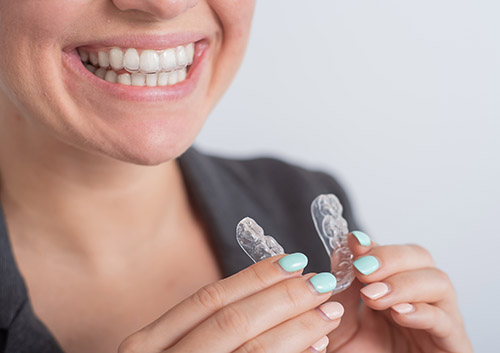
First, let’s clarify what we mean about clear braces. We’re not talking about clear aligners, which can be a great option if you want treatment that is a) removable and b) almost invisible. But sometimes only traditional brackets-and-wires braces will do when it comes to your orthodontic treatment. Does this mean you can’t opt for a more subtle, less visible treatment plan?

No! Orthodontic advances in materials and design mean that you have more options than ever before when it comes to selecting brackets and wires. If you prefer more inconspicuous braces for professional or personal reasons, some of the current options in clear braces might be just the (inconspicuous) look for you.

“Clear braces” can refer to several styles of brackets and wires:

  • Brackets themselves can be crafted in porcelain, ceramic, or plastic. High quality materials make them strong and stain-resistant.
  • Brackets can be transparent or can be carefully tinted to blend in with your enamel.
  • Some of these brackets require the usual ligatures (those tiny rubber bands holding the wire to the brackets), so it’s important to choose a band color to coordinate for a monochromatic look.
  • Some of these brackets are self-ligating, designed to hold the archwire with built-in clips and needing no ligatures at all.
  • Finally, there are coated and even non-metallic archwires that are designed to blend in with your enamel color and work without calling attention to themselves. Depending on your individual bite and tooth alignment, these wires might be an option.

Some of the common questions about clear braces include:

  • Can everyone use clear braces?

While clear braces generally function just as traditional metal braces do, there are some cases where they might not be ideal depending on the amount and type of alignment and bite correction you need. Dr. Tony Skanchy will let you know the best options to treat your orthodontic problems as effectively as possible.

  • Are they as strong as typical metal braces?

Clear brackets are quite strong, but they’re not as durable as metal brackets. If you choose porcelain, ceramic, or plastic brackets, we’ll give you all the information you need for their care.

  • Do clear braces take longer to work?

They might take a bit more time to bring your teeth into alignment, or they could work just as quickly as traditional braces. They often take less time than aligners. Today’s orthodontic treatments work more efficiently and therefore more quickly than ever before, so if there are any differences in wear-time, they probably won’t be significant.

Your individual orthodontic needs will dictate how long any treatment plan will take, and if different treatment options will add or save you time. Before you choose any orthodontic plan, we’ll go over all your options and give you an estimate for treatment time for each of them.

  • Any notable differences from metal brackets?

Clear brackets can be larger than metal versions. Because they can also be somewhat abrasive, they might be suggested only for your upper teeth. We’ll let you know if these brackets are a good fit for you.

  • Do clear braces stain?

Today’s clear brackets aren’t prone to staining—that would certainly defeat the purpose of choosing them! We’ll give you instructions on keeping them as clean and clear as possible. Do remember, if you use ligatures, that these little bands can stain if your diet is big on coffee, tea, cola, blueberries, or any other colorful food.

  • Are clear braces more expensive?

Cost of treatment is based on several factors, including the type of braces you select. We’ll be happy to compare the costs of your various treatment options.

If you want the benefits of traditional braces, but don’t necessarily want the visibility of regular metal brackets, consider the many transparent and tinted options available. Want more clarity? Talk to a member of our Sandy, UT orthodontic team! You might discover that clear braces are the clear choice to create your healthy, beautiful smile.

Bells and Whistles for Your Bristles?

November 2nd, 2022

Modern dentistry has made the most of today’s technological innovations. And we’ve come a long way from the fraying sticks our ancestors used as toothbrushes.

On the other hand, while it’s a lot better than a fraying stick, the manual toothbrush model you’ve used for years might be ready for an upgrade. Should you take this opportunity to try out some new technology offering all the bells and whistles? Let’s answer that question by asking a few more questions.

Happy with your manual brush?

If you like your manual toothbrush and it’s doing the job, by all means, stick with it. But even your old familiar brush can evolve:

  • There are lots of bristle options, but soft bristles are almost always the way to go. Medium and hard bristles can be too abrasive for your enamel.
  • Heads come in a variety of sizes, so make sure the head size is comfortable. You want to be able to maneuver to reach every tooth surface, which a too-large brush head just can’t do.
  • Try a different handle shape if you’re having trouble maneuvering and keeping a firm grip.
  • Change your brush regularly. Brushes are effective for about three months before the bristles start to fray and breakdown. This is a good opportunity to experiment with different brands and styles.

Does your old brush suit your current needs?

Different types of manual toothbrushes are available for effective and comfortable brushing when you need options that a typical brush doesn’t provide:

  • Special orthodontic toothbrushes are designed with bristles trimmed to fit around brackets and wires and smaller heads to reach into tight places.
  • For those with mobility issues, brushes with larger or easy-grip handles make cleaning more comfortable.
  • Brushes with extra-soft bristles are available if you have enamel erosion or sensitive gums.
  • Because many women find their gums become especially sensitive during pregnancy, there are brushes designed especially for moms-to-be.

Is it time to go electric?

If you haven’t tried an electric toothbrush before, you might find that getting braces is a great reason to give one a spin.

  • Electric toothbrushes can outperform manual models. A dedicated brusher might manage hundreds of brushstrokes for each minute of brushing, while an electric brush can provide thousands. If, despite your regular brushing, you have plaque build-up, an electric brush might be a good alternative to your manual brush.
  • Models are available which can alert you when you’re brushing too hard—which is important for your enamel if you’re a heavy-handed brusher.
  • If you tend to *think* you’ve brushed for the recommended two minutes, but have *actually* brushed 32 seconds, some electric brushes come with timers!
  • There are tapered electric orthodontic brush heads designed just for people with braces.
  • Electric brushes have bigger handles and can be easier to grip.

Is your current brush doing the job?

So, should you stick with the familiar toothbrush that’s worked for you all these years, or take this opportunity to try out some new technology that offers all the bells and whistles? The answer is clear: the right brush for you is the one that works!

If your regular checkups show that plaque is under control, you’re doing just fine with the brush in hand. If you or Dr. Tony Skanchy notice plaque buildup, it’s time to consider making some changes. Whether it’s a question of tools, techniques, or time spent brushing, your Sandy, UT dental team has the answers you need for state-of-the-art dental hygiene.

Getting a Retainer? Make It Personal!

October 26th, 2022

If Dr. Tony Skanchy and our team recommend a Hawley retainer to complete your orthodontic treatment, you’re getting a classic. This retainer, invented by Dr. Charles Hawley, has been in use since the early decades of the twentieth century.

But this isn’t your great grandmother’s pink plastic retainer! The look of today’s Hawley retainer has really evolved from its early days as the “Hawley bite plate”—and pink is now a choice instead of an inevitability. In fact, you can choose from any number of colors, patterns, and designs to create a retainer that is uniquely you.

Each Hawley retainer is customized to fit your mouth and teeth perfectly. Wire clasps and a labial bow wire are securely attached to an acrylic base based on a model made from your teeth and mouth.

Your retainer is designed for function—the bow wire makes sure your teeth stay in the perfect position while your bones and ligaments get strong enough to hold them in place. The acrylic base, of course, is also functional—but that doesn’t mean you can’t have fun with it!

Retainer bases can be formed in different ways.  One type of retainer model uses pre-formed acrylic discs for the base, and these are available in many pre-formed colors and patterns. Another type of retainer builds the base by alternating several applications of liquid and powder acrylics, layer after layer. This process allows the retainer technician to create one-of-a-kind designs.

What are some of the ways to make your retainer uniquely yours?

  • Color—whether deep tones, pastels, electrics, neon, or metallic, you can find an appealing shade in the color chart. Or, if you want your retainer to keep a low profile, choose a clear or a color-coordinated pink tone.
  • Glow in the Dark—if you don’t want your retainer to keep a low profile, this might be just the look for you!
  • Glitter—accessorize your sparkling smile with a sparkling retainer.
  • Patterns—stripes, polka dots, geometric shapes—even animal patterns are possible.
  • Color Combinations—why choose one color when you can have a marbled swirl of your favorites? Or a tie-dye look? Or team colors?
  • Acrylic Designs—a colorful design that captures your personality is available with some creative acrylic artistry. Rainbows and flags, hearts and flowers, ladybugs, and spider webs are just some of the options on hand.
  • Picture Perfect—for that special hobby, pet, team, or other personal favorite, decals or pictures can be applied under a layer of clear acrylic.

Hawley retainers are made to last, so choose your design with years of use in mind. Talk to our Sandy, UT team about the custom looks which are available to celebrate your unique personality. After all, there’s nothing more personal than your smile!

Midline Misalignment

October 19th, 2022

By and large, the human body is a marvel of symmetry. But, of course, no one is perfect. You might have noticed one ear is a bit higher than the other. That you wear a shoe a half-size bigger on your left foot. That one shirtsleeve always looks longer.

Or that your smile looks off-center. This dental asymmetry could be caused by a condition known as “midline misalignment,” and, unlike that left foot, you can do something about it!

The dividing line between our center teeth, upper and lower, is called the midline. If we draw an imaginary line down the middle of a face, from the forehead to the nose to the midpoint of the chin, that line should go right between the front teeth. When it doesn’t, because the teeth have shifted past the midpoint, it’s often due to a condition called midline misalignment.

This kind of misalignment, also known as a deviated midline, can have several causes:

  • Baby teeth that are lost too early

Baby teeth do more than promote healthy eating and speech development. They also reserve space for permanent teeth. If a primary tooth is lost too early, permanent teeth might “drift” to fill the empty space, causing the midline to move as well.

  • Thumb sucking that goes on too long

As a child gets older, and certainly when by the time permanent teeth start to arrive, aggressive thumb sucking can lead to numerous orthodontic problems, including a deviated midline, as the teeth shift in response to that continuous pressure.

  • Missing adult teeth

When you lose a tooth through decay or trauma, or when an adult tooth simply never develops, the remaining teeth can shift over to fill the open spot.

  • Spacing issues

Crowded teeth, teeth with significant gaps between them, very large teeth, very small teeth—all of these issues can affect spacing and midline alignment.

  • Crossbite

A crossbite is a kind of malocclusion, or bite problem. When you have a crossbite, the teeth don’t fit together properly, with upper teeth fitting inside lower teeth, instead of aligning on the outside where they belong. A deviated midline can indicate a posterior crossbite, where the top back teeth slant inwards or fit inside the bottom back teeth.

A tiny bit of midline shift one way or the other might be nothing to worry about, but if one front tooth is literally the center of attention, or if your teeth are noticeably out of alignment, it’s a good idea to talk to our Sandy, UT orthodontic team.

Because there are several potential causes for midline misalignment, Dr. Tony Skanchy will carefully analyze your individual situation to determine where the problem lies: with the teeth, the bite, or, rarely, the jaw itself.

Dr. Tony Skanchy will also offer you your best dental treatment options. A shift of a few millimeters might be treated with clear aligners or traditional braces. A crossbite could require braces or aligners coupled with elastics (rubber bands) to bring your bite into alignment. A palatal expander can help correct a serious crossbite.

Why visit Alta View Orthodontics because of a little asymmetry? Because a deviated midline is more than a cosmetic concern. If you have a malocclusion to begin with, or if your misalignment leads to changes in chewing habits, which cause new bite problems, you might be facing jaw pain, chipped and cracked teeth, headaches, and all the other unpleasant consequences of malocclusion.

By and large, perfect symmetry in life is unattainable. But if you want a smile that is well-balanced and healthy, talk to us about all the treatments available to make sure your smile—and not a single tooth—is the center of attention.

Back to Top